Hydrogen storage for photovoltaic power plants: Technology and Applications

Nowadays, renewable energy is becoming an increasingly popular source of power and photovoltaic power plants are playing a key role in this energy revolution. However, one of the challenges of producing energy from solar panels is storing it for times when the sun is not available. Hydrogen storage facilities are one of the innovative solutions that allow electricity to be stored in the form of hydrogen and used later.
How to build hydrogen storage for photovoltaic power plants and their applications.
How to build hydrogen storage for photovoltaic power plants and their applications.
At least three key components are needed to build hydrogen storage for photovoltaic power plants:
- Water electrolysers: Water electrolysers are devices that are used to break down water into hydrogen and oxygen using electricity. In hydrogen storage, electrolysers are used to produce hydrogen from the excess electricity produced by the photovoltaic power plant at times when energy consumption is low.
- Storage chamber: This is the room in which the hydrogen is stored. It must be designed to ensure safe storage of hydrogen, which is flammable and explosive. Different types of pressure vessels can be used in hydrogen storage, but those made of steel or composites are the most commonly used.
- Hydrogen collection station: This is a device that allows hydrogen to be taken from storage and delivered to a photovoltaic power plant for use as fuel for electricity generation. The station must be equipped with special filters that remove impurities from the hydrogen and provide clean fuel for the power plant.
The construction of a hydrogen storage facility for photovoltaic power plants must also take into account safety issues such as appropriate fire protection and alarm systems.

There are three basic types of water electrolysers:
- Alkaline electrolysers: these are the most commonly used water electrolysers. They work by electrolysing water in an alkaline solution, such as sodium hydroxide (NaOH) or potassium hydroxide (KOH) solution. Alkaline electrolysers are relatively simple in design and easy to operate, as well as being inexpensive.
- High-pressure electrolysers: also known as membrane electrolysers, they use membranes to separate hydrogen from oxygen, allowing the electrolysis of water to be carried out without the use of an alkaline solution. They are more energy efficient than alkaline electrolysers and are mainly used in the chemical and petrochemical industries.
- High-temperature electrolysers: also known as oxide electrolysers, they work by passing current through oxide electrodes such as zirconium oxide or aluminium oxide. They are more complex in design than alkaline and high-pressure electrolysers, but allow high efficiencies and are more energy efficient. They are mainly used in the metallurgical industry.
PEM electrolyser
Proton Exchange Membrane (PEM) electrolyser: This type of electrolyser requires a relatively high operating pressure, typically in the range of 1-3 atmospheres (100-300 kPa). The optimum operating temperature of a PEM electrolyser is usually around 70-80°C.
The PEM electrolyser may also be used as a fuel cell.
When used as an electrolyser, the device requires electricity to split water into hydrogen and oxygen. In contrast, when used as a fuel cell, the electrochemical reaction occurs in reverse and hydrogen and oxygen are combined, generating electricity.
The estimated energy loss associated with transforming 1 kWh of electricity to hydrogen in a PEM electrolyser and then converting it back to electricity in a PEM fuel cell is approximately 30-50%. In reality this loss depends on several factors, such as electrolyser efficiency, hydrogen purity, fuel cell efficiency, temperature and operating pressure.
The performance of the electrolyser and fuel cell depends on a number of factors, such as:
Electrolyte efficiency – electrolytes used in electrolysers and fuel cells must have a high ionic conductivity to allow hydrogen and oxygen ions to flow between electrodes. The higher the ionic conductivity, the more efficient electrolysers and fuel cells will be.
Temperature – the operating temperature of electrolysers and fuel cells has a major impact on their performance. For electrolysers, a higher temperature increases the reaction rate, which can improve the efficiency of the electrolysis process. For fuel cells, a lower temperature usually leads to higher efficiency, as the electrochemical efficiency of the reaction is then increased.
Pressure – higher pressure usually increases the efficiency of an electrolyser because it accelerates the passage of gases through the electrolytic membrane. For fuel cells, pressure usually does not affect performance as much as temperature.
Type and quality of catalyst – catalysts are essential in electrolysis and fuel cell energy production processes. Their effectiveness depends on their type and quality, as well as on the process conditions.
Raw material purity – the purity of the water and gas used in electrolysis and fuel cells affects their performance. Impurities can adversely affect the performance of the electrolyser and fuel cells, as well as the life of their components.
Hydrogen compression
To compress the hydrogen in the tank, a special hydrogen compressor must be used, which is equipped with components made of materials resistant to hydrogen cracking. Hydrogen compressors are usually piston or screw type. It is important that the compressor is equipped with adequate safety features to prevent overheating and other failures during operation.
Hydrogen collection stations
A hydrogen collection station is an advanced device used to extract hydrogen from storage, process it and supply it to a photovoltaic power plant. The water that is electrolysed may contain various contaminants, such as carbon oxides, sulphur compounds and metals, which can adversely affect the performance and durability of the photovoltaic power plant. Therefore, the hydrogen collection station must be equipped with special filters that remove these impurities and provide clean fuel for the power plant.
There are different types of filters that can be used in hydrogen collection stations, depending on the type of contaminants that need to be removed. For example, carbon filters are effective at removing carbon oxides and other organic compounds, while catalytic converters can remove sulphur and metal compounds.
In addition, the hydrogen receiving station must be equipped with monitoring and control systems to ensure the safe and efficient collection, processing and delivery of hydrogen to the photovoltaic power plant. These systems may include sensors that monitor hydrogen pressure and temperature, alarm systems that notify operators of process failures or irregularities, and control systems that regulate hydrogen flow and maintain optimal station operating conditions.
Ultimately, hydrogen collection stations are key components of the hydrogen infrastructure that enables the production, storage and distribution of hydrogen as a green fuel for photovoltaic power plants and other renewable energy sources.
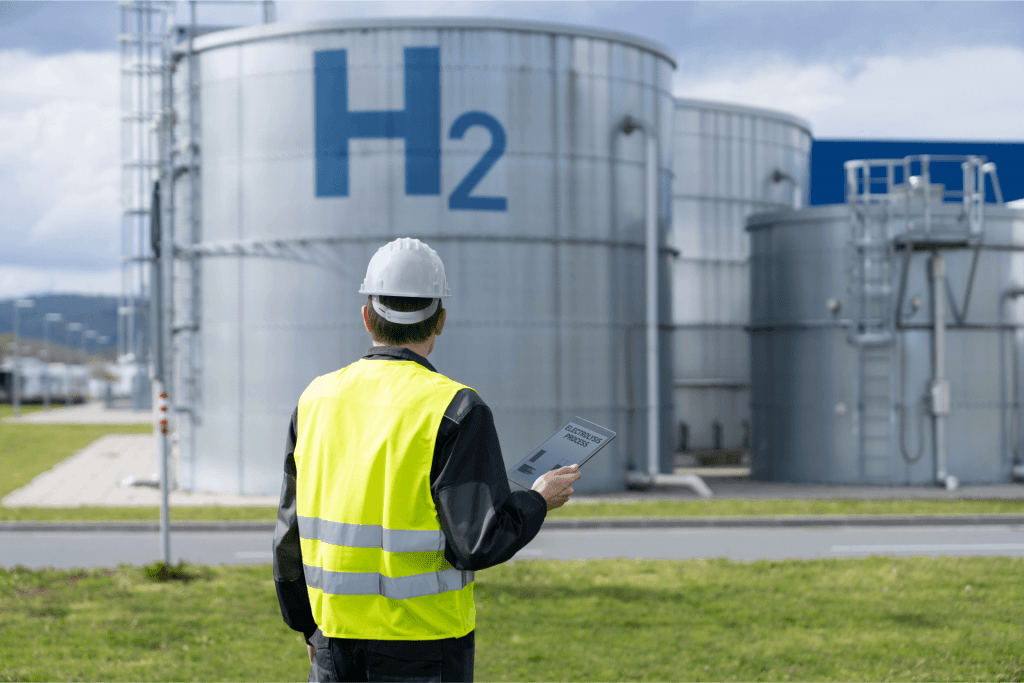
Hydrogen storage applications for photovoltaic power plants:
- Energy storage: allows the electricity produced by the PV plant to be stored at times when there is an excess, and then used during periods of low solar access.
- Stabilising the electricity grid: hydrogen storage can help maintain the stability of the electricity grid by providing the flexibility to deliver energy at the right times.
- Hydrogen vehicle fuelling: hydrogen fuel is an increasingly popular source of propulsion for vehicles. Hydrogen storage can supply hydrogen to vehicle refuelling stations.
- Heat production: hydrogen storage can be used for domestic and industrial heat production.
- Sustainable industrial production: hydrogen storage can supply hydrogen to various industrial processes that require a clean energy source.
- Supply to the gas grid: hydrogen storage can supply hydrogen to the gas grid, allowing it to be used in a variety of industrial applications.
Summary:
Hydrogen storage is a promising technology that can help to make efficient use of the electricity produced by photovoltaic power plants. This includes storing excess energy in the form of hydrogen, which can then be used in a variety of applications, such as power generation, vehicle propulsion or industrial processes. Choosing the right type of electrolyser and safety features is crucial for the safe and efficient operation of hydrogen storage. As the technology develops, hydrogen storage can be expected to play an increasingly important role in the future of renewable energy.
"Green hydrogen for the home"
Together with Polish research centers, we are working on new projects based on energy storage in the form of high-pressure hydrogen storage, obtained by water electrolysis or gas reforming.
Read about the project
Contact us
Fill out the form and we'll get back to you.